Acacia loderi: taxon details and analytics
- Domain
- Kingdom
- Plantae
- Phylum
- Tracheophyta
- Class
- Magnoliopsida
- Order
- Fabales
- Family
- Fabaceae
- Genus
- Acacia
- Species
- Acacia loderi
- Scientific Name
- Acacia loderi
Summary description from Wikipedia:
Acacia loderi
Acacia loderi, known colloquially as nelia or nealie, is a species of Acacia native to Australia.
Joseph Maiden described Acacia loderi in 1920 and it still bears its original name. It was named after its collector, assistant forester at Broken Hill A.C. Loder who collected it at Yancowinnia near Broken Hill in November 1907. The common name nelia and its former variants nealie and neelya are derived from the Ngiyambaa word nhiil'i for the species.
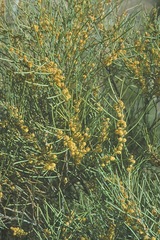
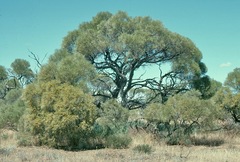
Acacia loderi grows as a large shrub or small tree 3–8 m (9.8–26.2 ft) high, with an erect or spreading habit. The bark is grey. Like all wattles it has leaf-like structures known as phyllodes instead of leaves. These are pale grey-green to green and very narrow and long, measuring 5–11 cm (2.0–4.3 in) in length by 0.9–2.5 mm (0.035–0.098 in) wide. The bright yellow flowers appear in spring (August to October).
Acacia loderi is found in inland southeastern Australia, mainly in far western New South Wales, from White Cliffs in the north of the tip of northwestern Victoria in the south, east to Hillston and west through the Darling River basin and Broken Hill into eastern South Australia, growing in colonized brown or red soils in mostly flat country. It forms a dominant component of Acacia loderi shrubland, where it is found with such trees as black oak (Casuarina pauper), inland rosewood (Alectryon oleifolius) and leopardwood (Flindersia maculosa), and an understory of chenopods and grasses.
Acacia loderi shrubland has been classified as an Endangered Ecological Community by the New South Wales Government. Key threats include clearing and excessive grazing by livestock.
The Wiradjuri people of New South Wales use the seeds of the species to make flour for bread, the fibrous bark for making string and rope, and the resin is eaten and can be used to make glue.
...Images from inaturalist.org observations:
We recommend you sign up for this excellent, free service.
Parent Taxon
Sibling Taxa
- Acacia abrupta
- Acacia acellerata
- Acacia adenogonia
- Acacia adnata
- Acacia amanda
- Acacia ammophila
- Acacia amyctica
- Acacia anaticeps
- Acacia ancistrophylla
- Acacia anfractuosa
- Acacia anserina
- Acacia arafurica
- Acacia argyrodendron
- Acacia argyrotricha
- Acacia armillata
- Acacia arrecta
- Acacia ascendens
- Acacia assimilis
- Acacia aulacophylla
- Acacia auratiflora
- Acacia auricoma
- Acacia auripila
- Acacia awestoniana
- Acacia baeuerlenii
- Acacia bakeri
- Acacia balsamea
- Acacia barattensis
- Acacia barrettiorum
- Acacia bartlei
- Acacia benthamii
- Acacia brachyphylla
- Acacia brachypoda
- Acacia burrana
- Acacia bynoeana
- Acacia caesariata
- Acacia calcicola
- Acacia cambagei
- Acacia campylophylla
- Acacia cana
- Acacia cassicula
- Acacia cavealis
- Acacia chapmanii
- Acacia chrysopoda
- Acacia cochlearis
- Acacia cognata
- Acacia colletioides
- Acacia comans
- Acacia complanata
- Acacia confusa
- Acacia consanguinea
- Acacia consobrina
- Acacia convallium
- Acacia coriacea
- Acacia cowaniana
- Acacia crenulata
- Acacia curvata
- Acacia cyclops
- Acacia dawsonii
- Acacia declinata
- Acacia deflexa
- Acacia delicatula
- Acacia deltoidea
- Acacia densiflora
- Acacia dictyoneura
- Acacia dielsii
- Acacia dissona
- Acacia dolichophylla
- Acacia donaldsonii
- Acacia dunnii
- Acacia dura
- Acacia duriuscula
- Acacia elongata
- Acacia enervia
- Acacia enterocarpa
- Acacia eremaea
- Acacia eremophila
- Acacia estrophiolata
- Acacia excelsa
- Acacia farinosa
- Acacia flavescens
- Acacia flavescens × leptoloba
- Acacia flavipila
- Acacia fleckeri
- Acacia formidabilis
- Acacia fragilis
- Acacia frigescens
- Acacia froggattii
- Acacia galeata
- Acacia gemina
- Acacia georginae
- Acacia gilesiana
- Acacia gracilifolia
- Acacia graciliformis
- Acacia hadrophylla
- Acacia harpophylla
- Acacia havilandiorum
- Acacia helmsiana
- Acacia hemignosta
- Acacia heteroclita
- Acacia heterophylla
- Acacia hexaneura
- Acacia homaloclada
- Acacia hylonoma
- Acacia implexa
- Acacia inceana
- Acacia ixiophylla
- Acacia johannis
- Acacia kalgoorliensis
- Acacia kauaiensis
- Acacia kenneallyi
- Acacia kingiana
- Acacia koa
- Acacia koaia
- Acacia lanei
- Acacia lanigera
- Acacia lanuginophylla
- Acacia latescens
- Acacia latipes
- Acacia latzii
- Acacia legnota
- Acacia leptoloba
- Acacia leptoneura
- Acacia lineolata
- Acacia lobulata
- Acacia loderi
- Acacia longispinea
- Acacia loxophylla
- Acacia lumholtzii
- Acacia mackeyana
- Acacia maconochieana
- Acacia manipularis
- Acacia maranoensis
- Acacia masliniana
- Acacia mathuataensis
- Acacia melanoxylon
- Acacia melvillei
- Acacia menzelii
- Acacia microcybe
- Acacia microsperma
- Acacia mimica
- Acacia mimula
- Acacia minutifolia
- Acacia monticola
- Acacia multisiliqua
- Acacia nitidula
- Acacia nivea
- Acacia nuperrima
- Acacia nyssophylla
- Acacia obesa
- Acacia obtecta
- Acacia obtriangularis
- Acacia octonervia
- Acacia omalophylla
- Acacia ommatosperma
- Acacia ophiolithica
- Acacia oraria
- Acacia orthotropica
- Acacia oswaldii
- Acacia papulosa
- Acacia papyrocarpa
- Acacia patagiata
- Acacia pelophila
- Acacia pendula
- Acacia perpusilla
- Acacia pharangites
- Acacia phlebocarpa
- Acacia pinguiculosa
- Acacia pinguifolia
- Acacia platycarpa
- Acacia praelongata
- Acacia prismifolia
- Acacia producta
- Acacia ptychoclada
- Acacia racospermoides
- Acacia ramiflora
- Acacia recurvata
- Acacia redolens
- Acacia resinistipulea
- Acacia resinosa
- Acacia retivenea
- Acacia richii
- Acacia ridleyana
- Acacia rigens
- Acacia rothii
- Acacia roycei
- Acacia sciophanes
- Acacia sclerophylla
- Acacia sericata
- Acacia sericophylla
- Acacia setulifera
- Acacia sibilans
- Acacia simsii
- Acacia speckii
- Acacia spectrum
- Acacia spongolitica
- Acacia stellaticeps
- Acacia stenophylla
- Acacia stipulosa
- Acacia subflexuosa
- Acacia sublanata
- Acacia subporosa
- Acacia subsessilis
- Acacia subternata
- Acacia sulcata
- Acacia tenuior
- Acacia tephrina
- Acacia tessellata
- Acacia tetanophylla
- Acacia tolmerensis
- Acacia torticarpa
- Acacia translucens
- Acacia trinalis
- Acacia trinervata
- Acacia trineura
- Acacia triptycha
- Acacia trulliformis
- Acacia uncinella
- Acacia undosa
- Acacia unguicula
- Acacia venulosa
- Acacia veronica
- Acacia verricula
- Acacia viscidula
- Acacia viscifolia
- Acacia vittata
- Acacia warramaba
- Acacia webbii
- Acacia whibleyana
- Acacia wilhelmiana
- Acacia wilsonii
- Acacia yirrkallensis