Buellia concinna: taxon details and analytics
- Domain
- Kingdom
- Fungi
- Phylum
- Ascomycota
- Class
- Lecanoromycetes
- Order
- Caliciales
- Family
- Caliciaceae
- Genus
- Buellia
- Species
- Buellia concinna
- Scientific Name
- Buellia concinna
Summary description from Wikipedia:
Buellia concinna
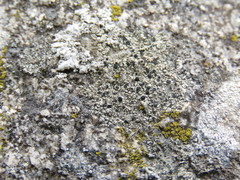
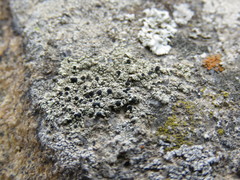
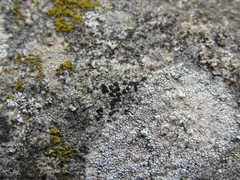
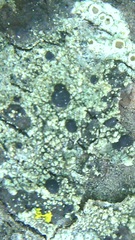
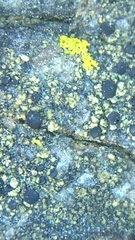
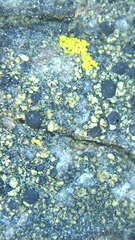
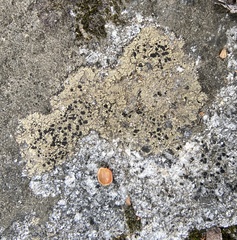
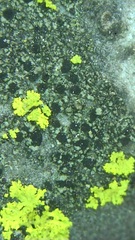
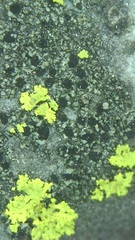
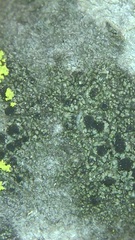
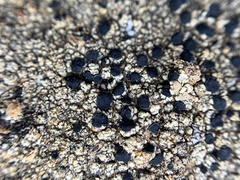
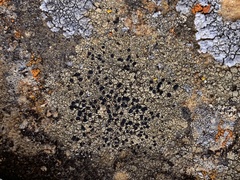
Buellia concinna, the cinnabar button lichen, is a pale yellow to greenish or brownish bullate (bubble-like) to granular crustose lichen that prefers siliceous rock and cliff faces in temperate to subarctic, subalpine and alpine climates throughout the Northern Hemisphere. In North America, it prefers higher altitudes such as in the Sierra Nevada range. Lecideine apothecia are sessile on the thallus and are .2–.8 mm (0.0079–0.0315 in) in diameter with black discs. Lichen spot tests are C+ orange or pinkish, K+ yellow, KC− but CK+ orange, and it is UV+ yellow to ultraviolet light. Secondary metabolites include arthothelin, isoarthothelin, 6-O-methylarthothelin, 4, 5-dichloronorlichexanthone, 4, 5-dichloro-6-O-methylnorlichexanthone, asemone, thiophanic acid, gyrophoric acid, lecanoric acid, and orsellinic acid.
...Images from inaturalist.org observations:
We recommend you sign up for this excellent, free service.
Parent Taxon
Sibling Taxa
- Buellia abstracta
- Buellia aequata
- Buellia aeruginosa
- Buellia aethalea
- Buellia aethaloessa
- Buellia akatorensis
- Buellia albinea
- Buellia albosparsa
- Buellia albula
- Buellia alectorialica
- Buellia alutacea
- Buellia ambuta
- Buellia anatolodia
- Buellia arborea
- Buellia arnoldii
- Buellia asterella
- Buellia aucklandica
- Buellia badia
- Buellia bahiana
- Buellia billewersii
- Buellia blahaiana
- Buellia bolacina
- Buellia brunnthaleri
- Buellia calcariaecola
- Buellia callaina
- Buellia callispora
- Buellia callisporina
- Buellia cangoensis
- Buellia capitis-regum
- Buellia christophii
- Buellia cingulata
- Buellia circumpallida
- Buellia citrina
- Buellia coeruleata
- Buellia concinna
- Buellia conspirans
- Buellia contingens
- Buellia cranwelliae
- Buellia crystallifera
- Buellia curatellae
- Buellia demutans
- Buellia desertica
- Buellia dialytella
- Buellia disciformis
- Buellia dispersa
- Buellia dissa
- Buellia distrahens
- Buellia dunedina
- Buellia eganii
- Buellia elegans
- Buellia elizae
- Buellia endorhodina
- Buellia epichlora
- Buellia epigaea
- Buellia erubescens
- Buellia ferax
- Buellia foecunda
- Buellia follmannii
- Buellia fosteri
- Buellia frigida
- Buellia galapagona
- Buellia georgei
- Buellia gerontoides
- Buellia glencairnensis
- Buellia glomerulans
- Buellia griseovirens
- Buellia gypsyensis
- Buellia halonia
- Buellia harrisiana
- Buellia haywardii
- Buellia homophylia
- Buellia hyperbolica
- Buellia hypopurpurea
- Buellia hypostictella
- Buellia immersa
- Buellia imshaugii
- Buellia incuriosa
- Buellia insidians
- Buellia insularicola
- Buellia insulina
- Buellia inturgescens
- Buellia jugorum
- Buellia kantvilasii
- Buellia lacteoidea
- Buellia langbaanensis
- Buellia lecanactina
- Buellia lepidastra
- Buellia leptocline
- Buellia leptoclinoides
- Buellia leucina
- Buellia lignoides
- Buellia lutata
- Buellia macularis
- Buellia maculata
- Buellia malcolmii
- Buellia mamillana
- Buellia marcidula
- Buellia maritima
- Buellia maungatuensis
- Buellia meizocarpa
- Buellia melanostola
- Buellia mexicana
- Buellia micraspis
- Buellia microbola
- Buellia miriquidica
- Buellia molonglo
- Buellia muriformis
- Buellia murina
- Buellia nantiana
- Buellia nashii
- Buellia navajoensis
- Buellia nesiotis
- Buellia nigra
- Buellia nitrophila
- Buellia occidentalis
- Buellia ocellata
- Buellia ocoteae
- Buellia oidalea
- Buellia oleicola
- Buellia olivacea
- Buellia pachnodes
- Buellia pachysporoides
- Buellia papanui
- Buellia parastata
- Buellia patearoana
- Buellia peregrina
- Buellia perigrapta
- Buellia permodica
- Buellia perspersa
- Buellia pleiotera
- Buellia poeltii
- Buellia porphyrilica
- Buellia procellarum
- Buellia prospersa
- Buellia pullata
- Buellia recepta
- Buellia rinodinea
- Buellia romoletia
- Buellia rorida
- Buellia rudis
- Buellia rufofuscescens
- Buellia rusticorum
- Buellia ryanii
- Buellia sanguinea
- Buellia saxorum
- Buellia schaereri
- Buellia schinziana
- Buellia sequax
- Buellia sharpiana
- Buellia silicicola
- Buellia sipmanii
- Buellia smaragdula
- Buellia springvalensis
- Buellia spuria
- Buellia stellulata
- Buellia stizenbergeri
- Buellia straminea
- Buellia subaethalea
- Buellia subalbula
- Buellia subbadioatra
- Buellia subcoronata
- Buellia subdisciformis
- Buellia subdispersa
- Buellia subtabacina
- Buellia sulphurica
- Buellia suttonensis
- Buellia tesserata
- Buellia tetrapla
- Buellia trachyspora
- Buellia transvaalica
- Buellia triplicans
- Buellia triseptata
- Buellia tuapekensis
- Buellia tyrolensis
- Buellia uberior
- Buellia vernicoma
- Buellia vilis
- Buellia violaceofusca
- Buellia zoharyi