Holocephali: taxon details and analytics
- Domain
- Kingdom
- Animalia
- Phylum
- Chordata
- Class
- Holocephali
- Order
- Family
- Genus
- Species
- Scientific Name
- Holocephali
Summary description from Wikipedia:
Holocephali
Holocephali (sometimes spelled Holocephala; Greek for "complete head" in reference to the fusion of upper jaw with the skull) is a subclass of cartilaginous fish. The only living holocephalans are the three families of chimaeras, but the group also includes many extinct members and was more diverse during the Paleozoic and Mesozoic eras. The earliest known fossils of holocephalans date to the Middle Devonian, and the subclass likely reached its peak diversity during the following Carboniferous Period. Molecular clock studies suggest that holocephalans diverged from their closest relatives, elasmobranchs such as sharks and rays, during the Early Devonian or the Silurian Period.
Extinct holocephalans are typically divided into a number of orders, although the relationships between these groups are poorly understood. Several different definitions of Holocephali exist, with the group sometimes considered a less inclusive clade within the larger subclasses Euchondrocephali or Subterbranchialia and with its members spread into the now obsolete groups Paraselachimorpha or Bradyodonti. Per these classification schemes, the name Holocephali is used only for chimaeras and their closest relatives. Recent research has suggested that the orders Cladoselachiformes and Symmoriiformes, which were historically considered relatives or ancestors of sharks, should instead be considered holocephalans. Information on the evolution and relationships of extinct holocephalans is limited, however, because most are known only from isolated teeth or dorsal fin spines, which form much of the basis of their classification.
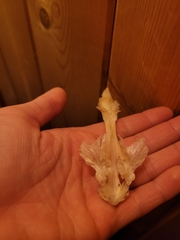
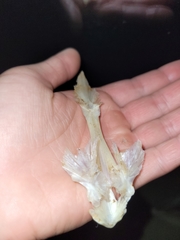
Chimaeras, the only surviving holocephalans, include mostly deep-sea species which are found worldwide. They all possess broad, wing-like pectoral fins, a single soft cover over the gills, upper jaws which are fused to the skull, and six plate-like crushing teeth in the mouth. Males possess both two sets of paired sex organs around the pelvic fins and an unpaired, toothed structure termed a cephalic clasper on the head. Females reproduce by laying large, leathery egg cases. The skin of living chimaeras lacks scales or armor plates, with the exception of tooth-like scales termed dermal denticles on the sensory and sex organs. Chimaeras are unique among vertebrates in that their tooth plates contain organs called tritors, which are made of the mineral whitlockite. Fossils similar to living chimaeras are known as far back as the Early Carboniferous.
While some resembled their living relatives, many extinct holocephalans had skulls and bodies which were unlike modern chimaeras. In members of extinct groups, the upper jaws were often not fused to the rest of the skull and the jaws supported rows of separate, shark-like teeth. The bodies of most extinct holocephalans were totally covered in dermal denticles, which in Paleozoic and Mesozoic members were sometimes fused into armor plates. Many extinct holocephalans were sexually dimorphic, and the males of some species possessed large grasping organs on the head. In some groups the teeth were specialized into fused, curled structures termed "tooth whorls", or arranged into flattened, crushing surfaces termed "tooth pavements". The shape of the teeth in many extinct holocephalans suggests they had a diet of shelled prey, although other species instead likely hunted softer prey like cephalopods or smaller fish. Fossils of holocephalans are most abundant in shallow marine deposits, although an extinct species is known from freshwater environments as well.
...Holocephali in languages:
- Arabic
- كاملات الرؤوس
- Bokmål
- helhoder
- Catalan
- Holocèfals
- Chinese
- 全頭綱
- Croatian
- Cjeloglavke
- Czech
- chiméry
- Dutch
- Draakvissen
- English
- Chimaeras
- Estonian
- Täispeased
- Finnish
- Koppapäiset
- French
- Holocéphales
- German
- Seekatzen
- Hebrew
- כסויי זימים
- Hungarian
- tömörfejűek
- Japanese
- 全頭亜綱
- Korean
- 전두어강
- Latvian
- Veselgalves
- Modern Greek
- Ολοκέφαλοι
- Polish
- Zrosłogłowe
- Portuguese
- Quimeras
- Russian
- Цельноголовые
- Sinhala
- කෛමේරාවන්
- Swedish
- helhuvudfiskar
- Thai
- ปลาฉลามผี ฯลฯ
- Ukrainian
- Суцільночерепні риби
Images from inaturalist.org observations:
We recommend you sign up for this excellent, free service.