Labeo weeksii: taxon details and analytics
- Domain
- Kingdom
- Animalia
- Phylum
- Chordata
- Class
- Actinopterygii
- Order
- Cypriniformes
- Family
- Cyprinidae
- Genus
- Labeo
- Species
- Labeo weeksii
- Scientific Name
- Labeo weeksii
Summary description from Wikipedia:
Labeo weeksii
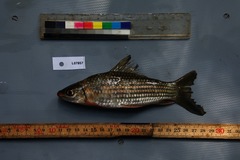
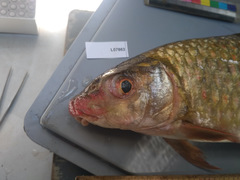
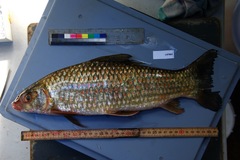
The rednose labeo (Labeo altivelis) is a species of fish in the family Cyprinidae, the carps and minnows. Other common names include Hunyani labeo, Manyame labeo, rednose mudsucker, and sailfin mudsucker. It is native to Africa, where it is distributed in the Democratic Republic of the Congo, Malawi, Mozambique, Zambia, and Zimbabwe.
This fish is about 27 centimetres (11 in) long at maturity. It has been known to reach 49 centimetres (19 in) in length and 3.6 kilograms (7.9 lb) in weight. Its maximum reported age is nine years.
This species is widely distributed in several African river systems and lakes, including the Congo, Luapala, Shire, Zambezi, Pungwe, Save, and Buzi Rivers and Lakes Mweru and Bangweulu. It is potamodromous, undertaking a migration through the river systems and into tributaries during the rainy season. In some areas, such as the Shire River of Malawi, it leaves the swollen rivers and swims out onto the floodplains, where it spawns.
The fish is benthopelagic, moving through deeper waters over the substrate, and grazing on algae and aufwuchs.
This is a food fish of seasonal commercial importance in some parts of its range. Its spawning events, known locally as kapata, can involve large aggregations of adult fish. During the spawning migration, many fish gather in the shallows of the floodplains, where they are easy to catch. The eggs are also collected for caviar. Overfishing occurs in some areas, and the resource is managed by some governments.
...Labeo weeksii in languages:
- Czech
- labeo Weeksovo
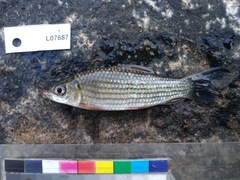
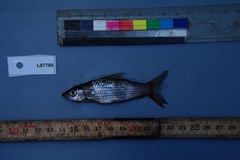
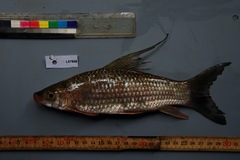
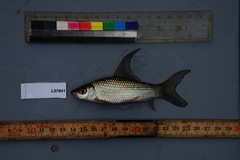
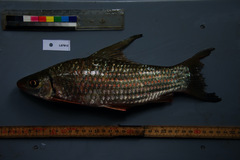
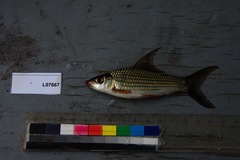
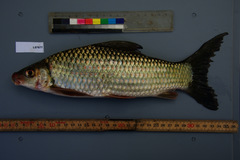
Images from inaturalist.org observations:
We recommend you sign up for this excellent, free service.
Parent Taxon
Sibling Taxa
- Labeo alluaudi
- Labeo alticentralis
- Labeo altivelis
- Labeo angra
- Labeo annectens
- Labeo ansorgii
- Labeo baldasseronii
- Labeo barbatulus
- Labeo barbatus
- Labeo bata
- Labeo batesii
- Labeo boga
- Labeo boggut
- Labeo bottegi
- Labeo boulengeri
- Labeo brachypoma
- Labeo caeruleus
- Labeo calbasu
- Labeo camerunensis
- Labeo capensis
- Labeo catla
- Labeo chariensis
- Labeo chrysophekadion
- Labeo congoro
- Labeo coubie
- Labeo curchius
- Labeo curriei
- Labeo cyclopinnis
- Labeo cyclorhynchus
- Labeo cylindricus
- Labeo degeni
- Labeo dhonti
- Labeo djourae
- Labeo dussumieri
- Labeo dyocheilus
- Labeo erythropterus
- Labeo falcipinnis
- Labeo filiferus
- Labeo fimbriatus
- Labeo fisheri
- Labeo forskalii
- Labeo fuelleborni
- Labeo fulakariensis
- Labeo gonius
- Labeo greenii
- Labeo gregorii
- Labeo heladiva
- Labeo horie
- Labeo indramontri
- Labeo inornatus
- Labeo kawrus
- Labeo kibimbi
- Labeo kirkii
- Labeo kontius
- Labeo lankae
- Labeo latebra
- Labeo lineatus
- Labeo lividus
- Labeo longipinnis
- Labeo lualabaensis
- Labeo lukulae
- Labeo luluae
- Labeo lunatus
- Labeo macrostoma
- Labeo meroensis
- Labeo mesops
- Labeo microphthalmus
- Labeo mokotoensis
- Labeo molybdinus
- Labeo nandina
- Labeo nasus
- Labeo nigrescens
- Labeo nigricans
- Labeo nigripinnis
- Labeo niloticus
- Labeo nunensis
- Labeo obscurus
- Labeo ogunensis
- Labeo pangusia
- Labeo parvus
- Labeo pellegrini
- Labeo percivali
- Labeo pierrei
- Labeo pietschmanni
- Labeo polli
- Labeo porcellus
- Labeo potail
- Labeo quadribarbis
- Labeo rajasthanicus
- Labeo rectipinnis
- Labeo reidi
- Labeo ricnorhynchus
- Labeo rohita
- Labeo rosae
- Labeo roseopunctatus
- Labeo rouaneti
- Labeo rubirostris
- Labeo rubromaculatus
- Labeo ruddi
- Labeo sanagaensis
- Labeo seeberi
- Labeo senegalensis
- Labeo shivamogaensis
- Labeo simpsoni
- Labeo sorex
- Labeo stolizkae
- Labeo trigliceps
- Labeo umbratus
- Labeo victorianus
- Labeo vulgaris
- Labeo weeksii
- Labeo werneri
- Labeo worthingtoni
- Phaeodermatium rivulare