Matelea alabamensis: taxon details and analytics
- Domain
- Kingdom
- Plantae
- Phylum
- Tracheophyta
- Class
- Magnoliopsida
- Order
- Gentianales
- Family
- Apocynaceae
- Genus
- Matelea
- Species
- Matelea alabamensis
- Scientific Name
- Matelea alabamensis
Summary description from Wikipedia:
Matelea alabamensis
Matelea alabamensis is a species of flowering plant in the dogbane family known by the common names Alabama milkvine, Alabama anglepod, and Alabama spiny-pod. It is native to the southeastern United States, where it occurs in Alabama, Georgia, and Florida.
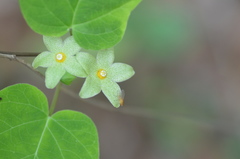
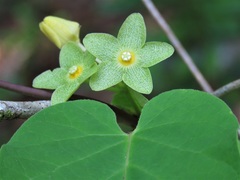
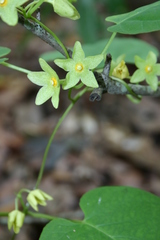
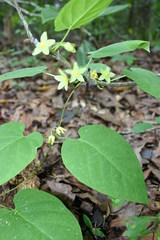
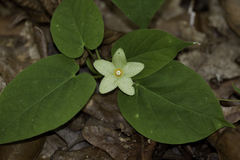
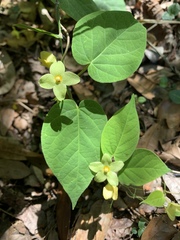
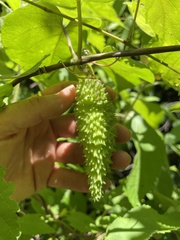
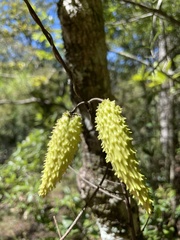
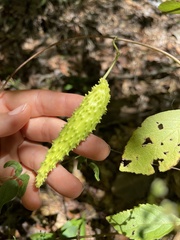
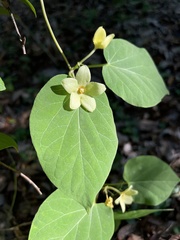
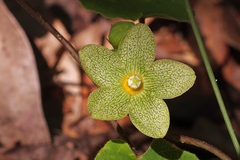
This rhizomatous perennial herb produces one to three stems which creep across the ground or twine around adjacent vegetation, reaching several meters in length. They are green or maroon-tinged, filled with a milky sap, and dotted with reddish glands on the newer parts. The oppositely arranged leaves are borne on petioles a few centimeters long which are covered in scattered hairs. The yellow-green leaf blades are up to 10 to 15 centimeters long. The inflorescence is an umbel of rotate flowers each about 2.5 centimeters across. The corolla has five yellow-green lobes with a green netting pattern. Flowering occurs in March through June. Flowering is more likely on vines that climb up, rather than spread along the ground. The fruit is a yellow-green, spiky follicle up to 10 centimeters long. The seeds have a tuft of long, white hairs at one end that help them disperse on the wind.
This plant grows in ravines in forests, generally in the area between the dry upper slopes and the moist lower slopes. The plant grows in areas where there are many other plants to climb but that also receive sunlight. The species is tolerant of shade but are more robust and produce more fruit in sunnier areas. The plant relies on regimes of natural disturbance to keep the forest open enough for it to thrive; in some areas the disturbance comes in the form of storms. The canopy is dominated by Magnolia grandiflora and Fagus grandifolia and sometimes oaks and hickories. Associated species include Quercus hemisphaerica, Q. virginiana, Q. nigra, Q. alba, Carya cordiformis, C. glabra, C. pallida, Prunus serotina, Tilia americana, Liquidambar styraciflua, Pinus echinata, P. taeda, and P. glabra, Cornus florida, Hamamelis virginiana, Ostrya virginiana, Carpinus caroliniana, Magnolia ashei, Prunus umbellata, Rhus copallina, Vaccinium arboreum, V. elliottii, Sebastiana fruticosa, and various lianas such as Vitis spp.
This is considered "one of rarest herbs in southeastern United States." The main threat to this rare species is the loss and degradation of its habitat. In Florida, some of the habitat has been converted to pine silviculture. While small amounts of logging may be beneficial to the plant by opening up the canopy, intense logging and clearcutting are destructive to the habitat. Erosion may follow. The plant is also affected by introduced species such as Lonicera japonica. Fire suppression has led to the loss of one vector of natural disturbance that keeps the forest open, leading to reduction of light levels, which results in decreased fruit production. Herbivory by caterpillars and perhaps deer is apparently a problem.
There are now "a couple dozen occurrences" remaining. Four populations are monitored at the Apalachicola Bluffs and Ravines Preserve by The Nature Conservancy.
...Images from inaturalist.org observations:
We recommend you sign up for this excellent, free service.
Parent Taxon
Sibling Taxa
- Matelea abbreviata
- Matelea acevedoi
- Matelea acuminata
- Matelea acutissima
- Matelea adenocardia
- Matelea alabamensis
- Matelea alainii
- Matelea altamirana
- Matelea ampiyacuensis
- Matelea andina
- Matelea angustifolia
- Matelea angustiloba
- Matelea annulata
- Matelea araneosa
- Matelea asplundii
- Matelea atrocoronata
- Matelea atrostellata
- Matelea attenuata
- Matelea australis
- Matelea bahiensis
- Matelea baldwyniana
- Matelea belizensis
- Matelea biflora
- Matelea boliviana
- Matelea brevicoronata
- Matelea calcarata
- Matelea calchaquina
- Matelea calcicola
- Matelea callejasii
- Matelea campechiana
- Matelea camporum
- Matelea carolinensis
- Matelea castanea
- Matelea caudata
- Matelea cervantesii
- Matelea chihuahuensis
- Matelea chimboracensis
- Matelea chrysantha
- Matelea congesta
- Matelea cordata
- Matelea crassifolia
- Matelea crenata
- Matelea cuatrecasasii
- Matelea cynanchoides
- Matelea decipiens
- Matelea decumbens
- Matelea delascioi
- Matelea denticulata
- Matelea ecuadorensis
- Matelea edwardsensis
- Matelea ekmanii
- Matelea elachyantha
- Matelea emmartinezii
- Matelea falcata
- Matelea flavidula
- Matelea floridana
- Matelea forerana
- Matelea fruticosa
- Matelea gentlei
- Matelea gonoloboides
- Matelea graciflora
- Matelea graciliflora
- Matelea gracilis
- Matelea greggii
- Matelea guatemalensis
- Matelea haberi
- Matelea harlingii
- Matelea hastulata
- Matelea hirtelliflora
- Matelea hispida
- Matelea honorana
- Matelea humboldtiana
- Matelea inconspicua
- Matelea inops
- Matelea ionantha
- Matelea jaramilloi
- Matelea johnstonii
- Matelea kirkbridei
- Matelea lanata
- Matelea lanceolata
- Matelea lehmannii
- Matelea lesueurii
- Matelea magallanesii
- Matelea medusae
- Matelea meyeri
- Matelea micrantha
- Matelea molinarum
- Matelea mutisiana
- Matelea nigrescens
- Matelea nipensis
- Matelea nummularia
- Matelea oaxacana
- Matelea obliqua
- Matelea ocellata
- Matelea ochracea
- Matelea ojadapantha
- Matelea orthoneura
- Matelea palustris
- Matelea panamensis
- Matelea parviflora
- Matelea parvifolia
- Matelea pastazana
- Matelea patalensis
- Matelea pedunculata
- Matelea petiolaris
- Matelea picturata
- Matelea pilosa
- Matelea porphyrantha
- Matelea porphyrocephala
- Matelea pringlei
- Matelea producta
- Matelea prostrata
- Matelea pubiflora
- Matelea pueblensis
- Matelea purpusii
- Matelea pusilliflora
- Matelea quercetorum
- Matelea radiata
- Matelea reflexa
- Matelea reticulata
- Matelea rhamnifolia
- Matelea rogersii
- Matelea romeroi
- Matelea sagittifolia
- Matelea sastrei
- Matelea schaffneri
- Matelea schultesii
- Matelea serpens
- Matelea sintenisii
- Matelea sprucei
- Matelea stenopetala
- Matelea stenosepala
- Matelea suberifera
- Matelea sugillata
- Matelea texensis
- Matelea tezcatlipocantha
- Matelea tlilxochitli
- Matelea trachyantha
- Matelea tristiflora
- Matelea tuerckheimii
- Matelea umbellata
- Matelea urophylla
- Matelea vailiana
- Matelea variifolia
- Matelea vaupesana
- Matelea velutina
- Matelea velutinoides
- Matelea woodsonii
- Matelea wootonii