Papilio oenomaus: taxon details and analytics
- Domain
- Kingdom
- Animalia
- Phylum
- Arthropoda
- Class
- Insecta
- Order
- Lepidoptera
- Family
- Papilionidae
- Genus
- Papilio
- Species
- Papilio oenomaus
- Scientific Name
- Papilio oenomaus
Summary description from Wikipedia:
Papilio oenomaus
Papilio oenomaus is a butterfly of the family Papilionidae. It is found on Timor and surrounding islands.
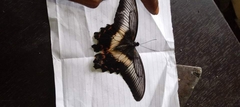
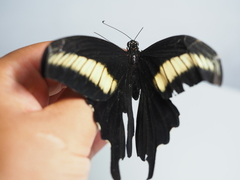
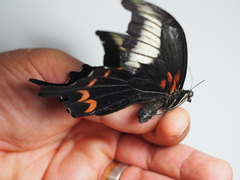
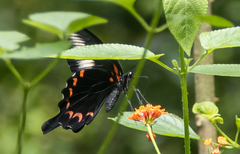
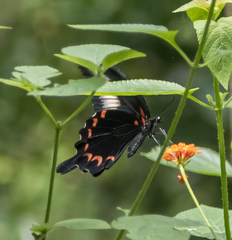
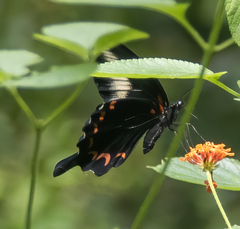
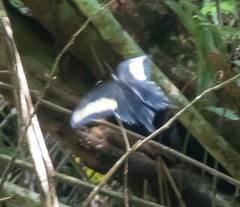
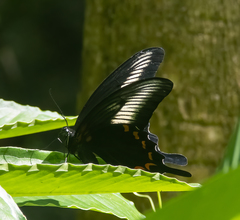
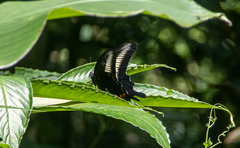
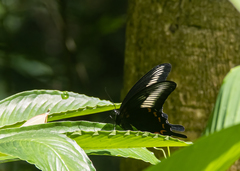
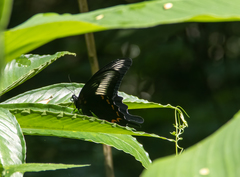
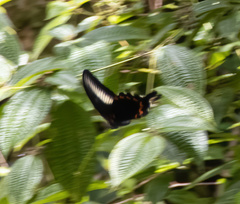
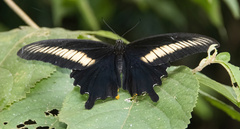
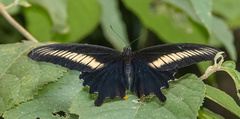
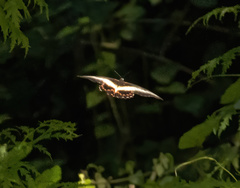
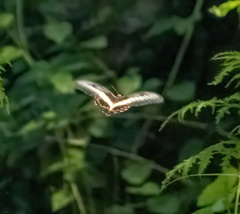
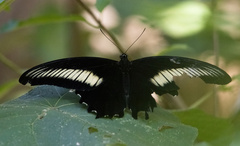
The wingspan is 120–130 mm. Black, tailed, entirely without blue scaling, the forewing elongate. Male forewing parallel with the distal margin with broad discal band which is pale yellow above, grey-white beneath; hindwing above without markings, beneath with a single row of yellowish red submarginal spots, which are remote from the cell and are sometimes indicated above also, and with 3 red basal patches. In the female the disc and cell of the forewing are semitransparent, the band is paler and the red basal patch, which in the male is only present beneath, is developed above also; on the hindwing a median band, which is reddish at its edges, the red submarginal spots above and beneath large, and the marginal spots reddish. The female is very similar to P. liris (Atrophaneura liris), and flies together with it. — oenomaus Godt. (28 b). occurs on Timor, Moa, Kisser and Roma (most probably also on the other small islands between Timor and Tenimber). The female with broad median band on the hindwing. Whilst P. liris is different on almost all the islands, oenomaus apparently shows no differences either in male or female on those mentioned above. On the other hand the following subspecies follows its model. — subfasciatus Rothsch. (28 b), from Wetter, is distinguished in the female by a very narrow, incomplete discal band on the hindwing, just as P. liris wettensis. This band is above and beneath pale red and usually interrupted before the cell, sometimes it is only faintly indicated beneath between costa and cell. The males are not constantly different to oenomaus; in general they have the band of the forewing somewhat narrower.
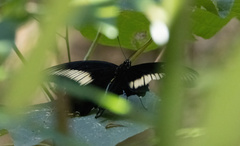
...Images from inaturalist.org observations:
We recommend you sign up for this excellent, free service.
Parent Taxon
Sibling Taxa
- Papilio acheron
- Papilio aegeus
- Papilio albinus
- Papilio alcmenor
- Papilio ambrax
- Papilio amynthor
- Papilio antonio
- Papilio ascalaphus
- Papilio bootes
- Papilio bridgei
- Papilio castor
- Papilio deiphobus
- Papilio demetrius
- Papilio demolion
- Papilio diophantus
- Papilio dravidarum
- Papilio duboisi
- Papilio euchenor
- Papilio forbesi
- Papilio fuscus
- Papilio gambrisius
- Papilio gigon
- Papilio godeffroyi
- Papilio helenus
- Papilio hipponous
- Papilio hystaspes
- Papilio inopinatus
- Papilio iswara
- Papilio iswaroides
- Papilio janaka
- Papilio jordani
- Papilio lampsacus
- Papilio liomedon
- Papilio lowii
- Papilio macilentus
- Papilio mayo
- Papilio memnon
- Papilio nephelus
- Papilio noblei
- Papilio oenomaus
- Papilio phestus
- Papilio pitmani
- Papilio polymnestor
- Papilio polytes
- Papilio prexaspes
- Papilio protenor
- Papilio rumanzovia
- Papilio sataspes
- Papilio schmeltzi
- Papilio thaiwanus
- Papilio tydeus
- Papilio weymeri
- Papilio woodfordi