Pseudophilautus mooreorum: taxon details and analytics
- Domain
- Kingdom
- Animalia
- Phylum
- Chordata
- Class
- Amphibia
- Order
- Anura
- Family
- Rhacophoridae
- Genus
- Pseudophilautus
- Species
- Pseudophilautus mooreorum
- Scientific Name
- Pseudophilautus mooreorum
Summary description from Wikipedia:
Pseudophilautus mooreorum
Pseudophilautus mooreorum, commonly known as Moore's shrub frog, is a species of frog in the family Rhacophoridae. It is endemic to Sri Lanka.
Its natural habitat is subtropical or tropical moist montane forests. Scientists have observed it in the Knuckles Hills between 1100 and 1245 meters above sea level.
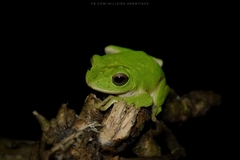
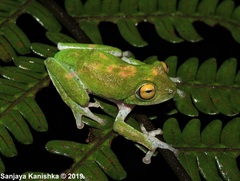
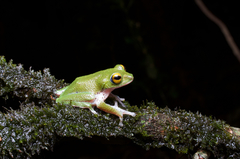
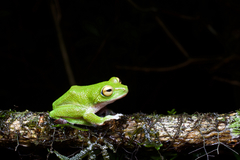
The adult male frog measures 29.4 – 31.3 mm in snout-vent length and the adult female 33.8 – 35.0 mm. The frog's head is a bright, luminous green color. The flanks are yellow and white in color. Parts of the mouth are white in color. The tops of the hind legs are green in color, and parts of the tops of the back legs are white in color. The toes of all four feet are white in color. This frog has disks on its toes for climbing. They are white in color.
This frog lives on shrubs. Scientists have seen the male frogs sitting in the shrubs in the understory 1–3 meters above the ground. They live in cloud forests where the trees form a closed canopy.
Like other frogs in Pseudophilautus, they grow through direct development, hatching as froglets rather than a free-swimming tadpole stage.
This frog is critically endangered. It is threatened by habitat loss. Scientists attribute this to urbanization, increased farming and pasturage, and logging.
...Pseudophilautus mooreorum in languages:
- English
- Moore's Shrub Frog
Images from inaturalist.org observations:
We recommend you sign up for this excellent, free service.
Parent Taxon
Sibling Taxa
- Pseudophilautus abundus
- Pseudophilautus adspersus
- Pseudophilautus alto
- Pseudophilautus amboli
- Pseudophilautus asankai
- Pseudophilautus auratus
- Pseudophilautus bambaradeniyai
- Pseudophilautus caeruleus
- Pseudophilautus cavirostris
- Pseudophilautus conniffae
- Pseudophilautus cuspis
- Pseudophilautus dayawansai
- Pseudophilautus decoris
- Pseudophilautus dilmah
- Pseudophilautus dimbullae
- Pseudophilautus eximius
- Pseudophilautus extirpo
- Pseudophilautus femoralis
- Pseudophilautus fergusonianus
- Pseudophilautus folicola
- Pseudophilautus frankenbergi
- Pseudophilautus fulvus
- Pseudophilautus hallidayi
- Pseudophilautus halyi
- Pseudophilautus hankeni
- Pseudophilautus hoffmanni
- Pseudophilautus hoipolloi
- Pseudophilautus hypomelas
- Pseudophilautus jagathgunawardanai
- Pseudophilautus kani
- Pseudophilautus karunarathnai
- Pseudophilautus leucorhinus
- Pseudophilautus limbus
- Pseudophilautus lunatus
- Pseudophilautus macropus
- Pseudophilautus maia
- Pseudophilautus malcolmsmithi
- Pseudophilautus microtympanum
- Pseudophilautus mittermeieri
- Pseudophilautus mooreorum
- Pseudophilautus nanus
- Pseudophilautus nasutus
- Pseudophilautus nemus
- Pseudophilautus newtonjayawardanei
- Pseudophilautus ocularis
- Pseudophilautus oxyrhynchus
- Pseudophilautus papillosus
- Pseudophilautus pardus
- Pseudophilautus pleurotaenia
- Pseudophilautus poppiae
- Pseudophilautus popularis
- Pseudophilautus procax
- Pseudophilautus puranappu
- Pseudophilautus regius
- Pseudophilautus reticulatus
- Pseudophilautus rugatus
- Pseudophilautus rus
- Pseudophilautus samarakoon
- Pseudophilautus sarasinorum
- Pseudophilautus schmarda
- Pseudophilautus schneideri
- Pseudophilautus semiruber
- Pseudophilautus silus
- Pseudophilautus silvaticus
- Pseudophilautus simba
- Pseudophilautus singu
- Pseudophilautus sirilwijesundarai
- Pseudophilautus sordidus
- Pseudophilautus steineri
- Pseudophilautus stellatus
- Pseudophilautus stictomerus
- Pseudophilautus stuarti
- Pseudophilautus tanu
- Pseudophilautus temporalis
- Pseudophilautus variabilis
- Pseudophilautus viridis
- Pseudophilautus wynaadensis
- Pseudophilautus zal
- Pseudophilautus zimmeri
- Pseudophilautus zorro