Urolophus viridis: taxon details and analytics
- Domain
- Kingdom
- Animalia
- Phylum
- Chordata
- Class
- Elasmobranchii
- Order
- Myliobatiformes
- Family
- Urolophidae
- Genus
- Urolophus
- Species
- Urolophus viridis
- Scientific Name
- Urolophus viridis
Summary description from Wikipedia:
Greenback stingaree
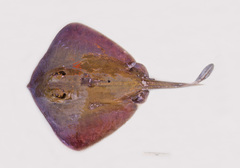
The greenback stingaree (Urolophus viridis) is a little-known species of stingray in the family Urolophidae, endemic to the outer continental shelf and upper continental slope off southeastern Australia. Growing to a length of 51 cm (20 in), this species has a diamond-shaped pectoral fin disc wider than long and uniformly light green in color above. Between its nostrils is a skirt-shaped curtain of skin. Its tail bears skin folds on either side and a deep, lanceolate caudal fin, but lacks a dorsal fin.
Usually found over soft substrates at a depth of 80–180 m (260–590 ft), the greenback stingaree is a predator of polychaete worms and crustaceans. It is aplacental viviparous, with developing embryos are sustained by maternally produced histotroph ("uterine milk"). Females bear litters of 1–3 pups annually after a 10–12 month gestation period. Substantial numbers of greenback stingarees are caught incidentally in trawls; captured rays rarely survive and also tend to abort their young. Stingaree populations on the New South Wales upper slope, presumably including this species, have declined precipitously as a result of commercial fishing. Consequently, the International Union for Conservation of Nature (IUCN) has listed the greenback stingaree as Vulnerable.
...Urolophus viridis in languages:
- Czech
- tlustoocaska zelená
- Dutch
- Groenrugdoornrog
- English
- Greenback Stingaree
- English
- Green-back Stingaree
- English
- Green-backed Stingaree
Images from inaturalist.org observations:
We recommend you sign up for this excellent, free service.
Parent Taxon
Sibling Taxa
- Urolophus aurantiacus
- Urolophus bucculentus
- Urolophus circularis
- Urolophus cruciatus
- Urolophus deforgesi
- Urolophus expansus
- Urolophus flavomosaicus
- Urolophus gigas
- Urolophus javanicus
- Urolophus kaianus
- Urolophus kapalensis
- Urolophus lobatus
- Urolophus mitosis
- Urolophus neocaledoniensis
- Urolophus orarius
- Urolophus papilio
- Urolophus paucimaculatus
- Urolophus piperatus
- Urolophus sufflavus
- Urolophus viridis
- Urolophus westraliensis