Zamia decumbens: taxon details and analytics
- Domain
- Kingdom
- Plantae
- Phylum
- Tracheophyta
- Class
- Cycadopsida
- Order
- Cycadales
- Family
- Zamiaceae
- Genus
- Zamia
- Species
- Zamia decumbens
- Scientific Name
- Zamia decumbens
Summary description from Wikipedia:
Zamia decumbens
Zamia decumbens, common name sinkhole cycad, is a species of cycad known only from Belize. The species was erroneously referred to in print several times as Z. prasina before its recognition as a distinct species. The species was (under the name Z. prasina) proposed for protection as a critically endangered species.
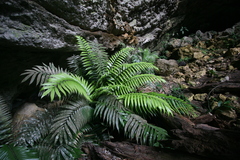
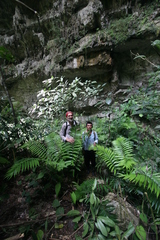
As of 2009, seven populations were known in the Maya Mountains, a few on ridges and mountaintops, but the largest populations at the bottom of sinkholes. Sinkholes are depressions in the earth caused by collapse of the roof of a cave. They very frequently are home to unusual plants and animals because they typically have water at the bottom, and the steep walls also protect the sinkholes from herbivores.
Zamia decumbens is unusual in the genus in having decumbent stems, i.e. trunks that run horizontally along the ground rather than growing straight up. The plant occasionally dies at the base while forming new roots higher up the stem. There are also a few differences in leaf shape and cone characters that distinguish it from other species in Belize.
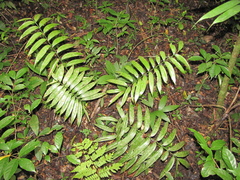
Zamia decumbens has sparingly branched cylindrical stems up to 80 cm long and up to 11 cm in diameter. Leaves number 5-17 per plant, each one up to 175 cm long, pinnately compound with up to 28 pairs of leaflets. Leaflets are up to 30 cm long and 5 cm across, lanceolate and gradually tapering toward tip. Microsporangiate strobili (male cones) are conical to cylindrical, up to 16.5 cm long and 2.5 cm in diameter. Megasporangiate strobili (female cones) are cylindrical, up to 20 cm long and 6.5 cm in diameter. Seeds are red, egg-shaped, up to 2 cm long.
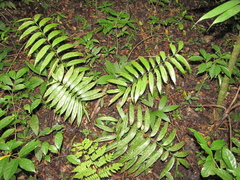
...Images from inaturalist.org observations:
We recommend you sign up for this excellent, free service.
Parent Taxon
Sibling Taxa
- Zamia acuminata
- Zamia amazonum
- Zamia amplifolia
- Zamia angustifolia
- Zamia boliviana
- Zamia brasiliensis
- Zamia chigua
- Zamia cremnophila
- Zamia cunaria
- Zamia decumbens
- Zamia disodon
- Zamia dressleri
- Zamia elegantissima
- Zamia encephalartoides
- Zamia erosa
- Zamia fairchildiana
- Zamia fischeri
- Zamia furfuracea
- Zamia gentryi
- Zamia gomeziana
- Zamia grijalvensis
- Zamia hamannii
- Zamia herrerae
- Zamia huilensis
- Zamia hymenophyllidia
- Zamia imperialis
- Zamia incognita
- Zamia inermis
- Zamia integrifolia
- Zamia ipetiensis
- Zamia lacandona
- Zamia lecointei
- Zamia lindenii
- Zamia lindleyi
- Zamia lindosensis
- Zamia loddigesii
- Zamia lucayana
- Zamia macrochiera
- Zamia manicata
- Zamia meermanii
- Zamia melanorrhachis
- Zamia montana
- Zamia monticola
- Zamia muricata
- Zamia nana
- Zamia nesophila
- Zamia neurophyllidia
- Zamia obliqua
- Zamia oligodonta
- Zamia onan-reyesii
- Zamia oreillyi
- Zamia orinoquiensis
- Zamia paucifoliolata
- Zamia paucijuga
- Zamia poeppigiana
- Zamia portoricensis
- Zamia prasina
- Zamia pseudomonticola
- Zamia pseudoparasitica
- Zamia pumila
- Zamia purpurea
- Zamia pygmaea
- Zamia pyrophylla
- Zamia restrepoi
- Zamia roezlii
- Zamia sandovalii
- Zamia skinneri
- Zamia soconuscensis
- Zamia spartea
- Zamia standleyi
- Zamia stenophyllidia
- Zamia stevensonii
- Zamia stricta
- Zamia tolimensis
- Zamia tuerckheimii
- Zamia ulei
- Zamia urep
- Zamia variegata
- Zamia vazquezii
- Zamia verschaffeltii
- Zamia wallisii
- Zamia × katzeriana