Atelopus mindoensis: taxon details and analytics
- Domain
- Kingdom
- Animalia
- Phylum
- Chordata
- Class
- Amphibia
- Order
- Anura
- Family
- Bufonidae
- Genus
- Atelopus
- Species
- Atelopus mindoensis
- Scientific Name
- Atelopus mindoensis
Summary description from Wikipedia:
Atelopus mindoensis
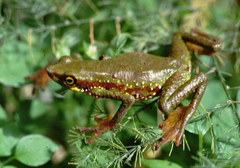
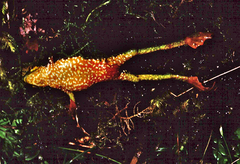
The Mindo stubfoot toad or Mindo harlequin toad (Atelopus mindoensis) is a species of toad in the family Bufonidae. It is endemic to Ecuador in Pichincha, Santo Domingo and Cotopaxi Provinces. Its natural habitats are subtropical or tropical moist lowland forests, subtropical or tropical moist montane forests, and rivers. It has a unique appearance and color pattern, being green and red with white speckles, and due to this it was once considered an emblematic species of the Mindo Valley.
It is threatened by chytridomycosis and habitat loss, and was previously feared extinct, being last seen in Pichincha Province on May 7, 1989. It was not seen again for over 30 years, and any hopes for its survival and rediscovery were considered "unlikely", as the cloud forests it lived in were the most well-documented in the country. However, a remnant breeding population was discovered in 2019 in a privately owned cloud forest preserve, and this discovery was documented in 2020. This makes A. mindoensis one of the many members of its genus to be rediscovered in the 21st century following decades of no sightings. Four tadpoles were discovered in the Arlequín Reserve in 2025, the first to be recorded and photographed.
...Atelopus mindoensis in languages:
- Czech
- atelopus průsvitný
- English
- Mindo Stubfoot Toad
- English
- Mindo Harlequin frog
- Russian
- Прозрачный арлекин
Images from inaturalist.org observations:
We recommend you sign up for this excellent, free service.
Parent Taxon
Sibling Taxa
- Atelopus andinus
- Atelopus angelito
- Atelopus ardila
- Atelopus arsyecue
- Atelopus arthuri
- Atelopus balios
- Atelopus barbotini
- Atelopus bomolochos
- Atelopus boulengeri
- Atelopus carauta
- Atelopus carbonerensis
- Atelopus carrikeri
- Atelopus certus
- Atelopus chiriquiensis
- Atelopus chirripoensis
- Atelopus chocoensis
- Atelopus chrysocorallus
- Atelopus coynei
- Atelopus cruciger
- Atelopus dimorphus
- Atelopus ebenoides
- Atelopus elegans
- Atelopus epikeisthos
- Atelopus erythropus
- Atelopus eusebianus
- Atelopus eusebiodiazi
- Atelopus exiguus
- Atelopus famelicus
- Atelopus farci
- Atelopus flavescens
- Atelopus franciscus
- Atelopus fronterizo
- Atelopus galactogaster
- Atelopus gigas
- Atelopus glyphus
- Atelopus guanujo
- Atelopus guitarraensis
- Atelopus halihelos
- Atelopus hoogmoedi
- Atelopus ignescens
- Atelopus laetissimus
- Atelopus limosus
- Atelopus loettersi
- Atelopus longibrachius
- Atelopus longirostris
- Atelopus lozanoi
- Atelopus lynchi
- Atelopus manauensis
- Atelopus mandingues
- Atelopus marinkellei
- Atelopus mindoensis
- Atelopus minutulus
- Atelopus mittermeieri
- Atelopus monohernandezii
- Atelopus moropukaqumir
- Atelopus mucubajiensis
- Atelopus muisca
- Atelopus nahumae
- Atelopus nanay
- Atelopus nepiozomus
- Atelopus nicefori
- Atelopus nocturnus
- Atelopus onorei
- Atelopus orcesi
- Atelopus oxapampae
- Atelopus oxyrhynchus
- Atelopus pachydermus
- Atelopus palmatus
- Atelopus pastuso
- Atelopus patazensis
- Atelopus pedimarmoratus
- Atelopus peruensis
- Atelopus petersi
- Atelopus petriruizi
- Atelopus pictiventris
- Atelopus pinangoi
- Atelopus planispina
- Atelopus podocarpus
- Atelopus pulcher
- Atelopus pyrodactylus
- Atelopus quimbaya
- Atelopus reticulatus
- Atelopus sanjosei
- Atelopus seminiferus
- Atelopus senex
- Atelopus sernai
- Atelopus simulatus
- Atelopus siranus
- Atelopus sonsonensis
- Atelopus sorianoi
- Atelopus spumarius
- Atelopus spurrelli
- Atelopus subornatus
- Atelopus tamaense
- Atelopus tricolor
- Atelopus varius
- Atelopus vogli
- Atelopus walkeri
- Atelopus zeteki