Physaria obcordata: taxon details and analytics
- Domain
- Kingdom
- Plantae
- Phylum
- Tracheophyta
- Class
- Magnoliopsida
- Order
- Brassicales
- Family
- Brassicaceae
- Genus
- Physaria
- Species
- Physaria obcordata
- Scientific Name
- Physaria obcordata
Summary description from Wikipedia:
Physaria obcordata
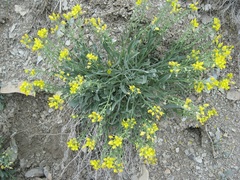
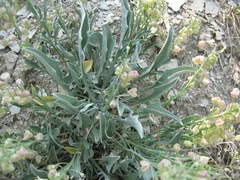
Physaria obcordata is a rare species of flowering plant in the family Brassicaceae known by the common name Dudley Bluffs twinpod. It is similar in appearance to the more common Piceance twinpod, but can be distinguished by looking at the leaves through a hand lens. The Piceance twinpod, Physaria acutifolia has stellate hairs when viewed through a hand lens while Physaria ocordata has markings that look like a satellite dish, or a circle with a dot in the middle. It is endemic to Colorado, where it is found only in the Piceance Basin in Rio Blanco County. It is threatened by the loss and degradation of its habitat. It is a federally listed threatened species of the United States.
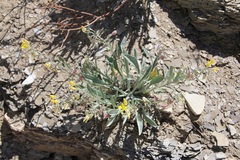
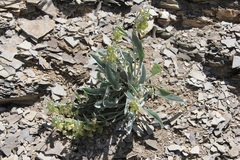
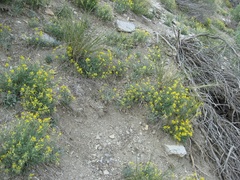
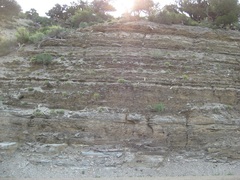
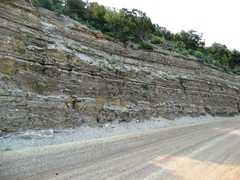
This plant was discovered in 1982 and described to science in 1983. Its Piceance Basin habitat is open, barren, and made up of white shale outcrops in the Green River Formation. The topography has been shaped by rivers cutting down through the substrate. Much of the rock is oil shale covering deposits of natural gas. Heavy petroleum exploration and extraction activities occur throughout the area, and the region is mined for minerals such as nahcolite and dawsonite. This mining and surveying activity is the main threat to the species and its relative, the Dudley Bluffs bladderpod (Physaria congesta). This threat is considered "imminent". 100% of the plant's habitat is potential territory for oil and mineral mining. The threat includes drilling activity as well as associated activities including road maintenance, pipeline installation, utilities, and construction of new housing and power plants. Increased pollution and dust may affect the plants.
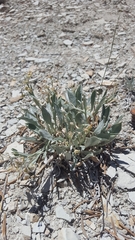
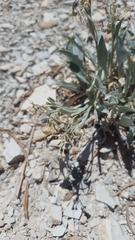
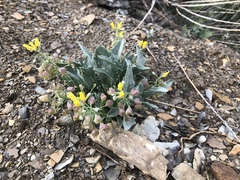
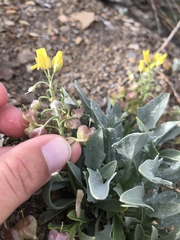
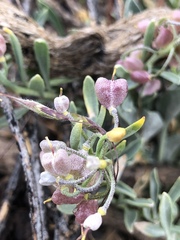
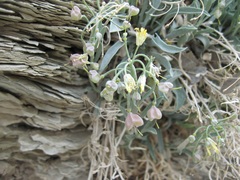
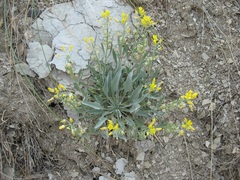
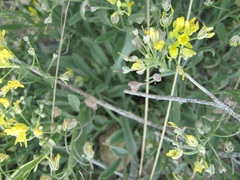
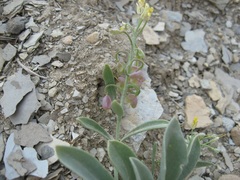
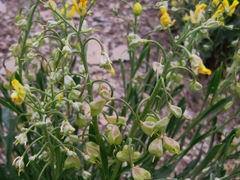
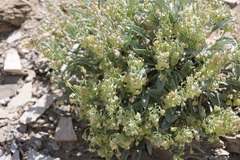
The Dudley Bluffs twinpod is a perennial herb with a branching caudex covered with the shredded remains of previous seasons' leaves. The erect stems grow 12 to 18 centimeters tall. The wide lance-shaped basal leaves are 4 to 8 centimeters long. The upper leaves are narrower but not much shorter. The inflorescence is a loose raceme of flowers with yellow-green sepals and yellow petals up to a centimeter in length. The heart-shaped fruit is a hanging, inflated silique that is papery in texture and roughly half a centimeter long. The plant is pollinated by bees of the genera Halictus, Lasioglossum, Dialictus, and Andrena.
Though rare overall with a very small distribution, this plant is locally abundant, with 10,000 individuals at one site. There are ten occurrences and an estimated total of up to 27,800 individuals.
...Physaria obcordata in languages:
- English
- Dudley Bluffs twinpod
Images from inaturalist.org observations:
We recommend you sign up for this excellent, free service.
Parent Taxon
Sibling Taxa
- Physaria acutifolia
- Physaria alpestris
- Physaria alpina
- Physaria angustifolia
- Physaria arctica
- Physaria arenosa
- Physaria argentea
- Physaria argyraea
- Physaria arizonica
- Physaria aurea
- Physaria bellii
- Physaria berlandieri
- Physaria brassicoides
- Physaria calcicola
- Physaria calderi
- Physaria carinata
- Physaria chambersii
- Physaria cinerea
- Physaria condensata
- Physaria congesta
- Physaria cordiformis
- Physaria curvipes
- Physaria densiflora
- Physaria didymocarpa
- Physaria dornii
- Physaria douglasii
- Physaria eburniflora
- Physaria engelmannii
- Physaria eriocarpa
- Physaria fendleri
- Physaria filiformis
- Physaria floribunda
- Physaria fremontii
- Physaria garrettii
- Physaria geyeri
- Physaria globosa
- Physaria gooddingii
- Physaria gordonii
- Physaria gracilis
- Physaria grahamii
- Physaria grandiflora
- Physaria hemiphysaria
- Physaria hitchcockii
- Physaria humilis
- Physaria inflata
- Physaria integrifolia
- Physaria intermedia
- Physaria iveyana
- Physaria johnstonii
- Physaria kaibabensis
- Physaria kingii
- Physaria klausii
- Physaria lata
- Physaria lateralis
- Physaria lepidota
- Physaria lesicae
- Physaria lindheimeri
- Physaria ludoviciana
- Physaria macrocarpa
- Physaria mcvaughiana
- Physaria mendocina
- Physaria mexicana
- Physaria mirandiana
- Physaria montana
- Physaria multiceps
- Physaria navajoensis
- Physaria nelsonii
- Physaria newberryi
- Physaria obcordata
- Physaria obdeltata
- Physaria occidentalis
- Physaria oregona
- Physaria ovalifolia
- Physaria pachyphylla
- Physaria pallida
- Physaria palmeri
- Physaria parviflora
- Physaria parvula
- Physaria pendula
- Physaria peninsularis
- Physaria pinetorum
- Physaria prostrata
- Physaria pruinosa
- Physaria pueblensis
- Physaria pulvinata
- Physaria purpurea
- Physaria pycnantha
- Physaria rectipes
- Physaria recurvata
- Physaria reediana
- Physaria rollinsii
- Physaria rosei
- Physaria saximontana
- Physaria schaffneri
- Physaria scrotiformis
- Physaria sessilis
- Physaria sinuosa
- Physaria spatulata
- Physaria subumbellata
- Physaria tenella
- Physaria thamnophila
- Physaria tumulosa
- Physaria urbaniana
- Physaria valida
- Physaria vicina
- Physaria vigana
- Physaria vitulifera
- Physaria wyndii