Physaria parvula: taxon details and analytics
- Domain
- Kingdom
- Plantae
- Phylum
- Tracheophyta
- Class
- Magnoliopsida
- Order
- Brassicales
- Family
- Brassicaceae
- Genus
- Physaria
- Species
- Physaria parvula
- Scientific Name
- Physaria parvula
Summary description from Wikipedia:
Physaria parvula
Physaria parvula (syn. Lesquerella parvula) is a species of flowering plant in the family Brassicaceae known by the common name pygmy bladderpod. It is native to the Western United States, where it can be found in Colorado, Utah, and Wyoming.
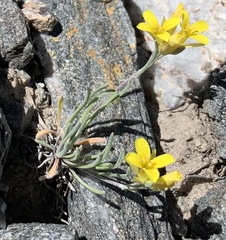
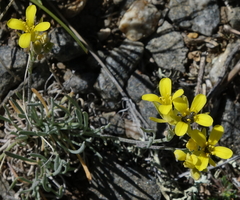
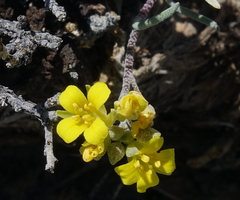
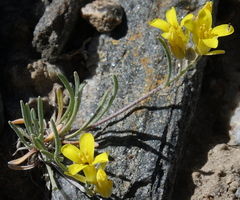
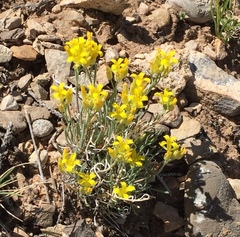
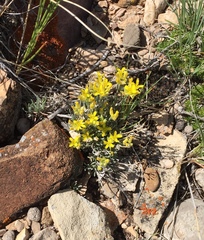
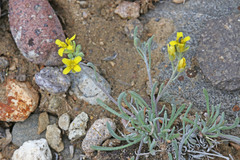
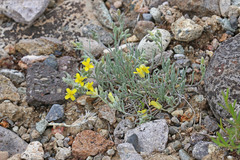
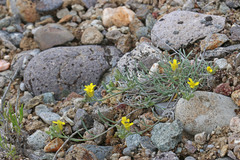
This plant is a tuft-forming perennial herb. It is gray-green in color due to a coating of branching hairs. Stems up to 15 centimeters tall arise from a caudex buried just underground. The leaves are linear in shape and measure 1 to 3 centimeters in length. The narrow leaves make the plant distinctive among the Physaria species growing in the area. The flowers have four clawed yellow petals each about half a centimeter long.
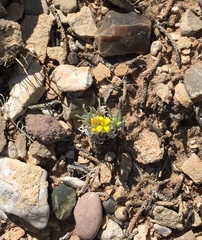
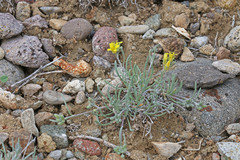
This plant grows in open areas in sagebrush and mountain shrub ecosystems. It may grow in areas with few or no other plants, such as areas that are windswept and harsh.
...Physaria parvula in languages:
- English
- Pygmy Bladderpod
Images from inaturalist.org observations:
We recommend you sign up for this excellent, free service.
Parent Taxon
Sibling Taxa
- Physaria acutifolia
- Physaria alpestris
- Physaria alpina
- Physaria angustifolia
- Physaria arctica
- Physaria arenosa
- Physaria argentea
- Physaria argyraea
- Physaria arizonica
- Physaria aurea
- Physaria bellii
- Physaria berlandieri
- Physaria brassicoides
- Physaria calcicola
- Physaria calderi
- Physaria carinata
- Physaria chambersii
- Physaria cinerea
- Physaria condensata
- Physaria congesta
- Physaria cordiformis
- Physaria curvipes
- Physaria densiflora
- Physaria didymocarpa
- Physaria dornii
- Physaria douglasii
- Physaria eburniflora
- Physaria engelmannii
- Physaria eriocarpa
- Physaria fendleri
- Physaria filiformis
- Physaria floribunda
- Physaria fremontii
- Physaria garrettii
- Physaria geyeri
- Physaria globosa
- Physaria gooddingii
- Physaria gordonii
- Physaria gracilis
- Physaria grahamii
- Physaria grandiflora
- Physaria hemiphysaria
- Physaria hitchcockii
- Physaria humilis
- Physaria inflata
- Physaria integrifolia
- Physaria intermedia
- Physaria iveyana
- Physaria johnstonii
- Physaria kaibabensis
- Physaria kingii
- Physaria klausii
- Physaria lata
- Physaria lateralis
- Physaria lepidota
- Physaria lesicae
- Physaria lindheimeri
- Physaria ludoviciana
- Physaria macrocarpa
- Physaria mcvaughiana
- Physaria mendocina
- Physaria mexicana
- Physaria mirandiana
- Physaria montana
- Physaria multiceps
- Physaria navajoensis
- Physaria nelsonii
- Physaria newberryi
- Physaria obcordata
- Physaria obdeltata
- Physaria occidentalis
- Physaria oregona
- Physaria ovalifolia
- Physaria pachyphylla
- Physaria pallida
- Physaria palmeri
- Physaria parviflora
- Physaria parvula
- Physaria pendula
- Physaria peninsularis
- Physaria pinetorum
- Physaria prostrata
- Physaria pruinosa
- Physaria pueblensis
- Physaria pulvinata
- Physaria purpurea
- Physaria pycnantha
- Physaria rectipes
- Physaria recurvata
- Physaria reediana
- Physaria rollinsii
- Physaria rosei
- Physaria saximontana
- Physaria schaffneri
- Physaria scrotiformis
- Physaria sessilis
- Physaria sinuosa
- Physaria spatulata
- Physaria subumbellata
- Physaria tenella
- Physaria thamnophila
- Physaria tumulosa
- Physaria urbaniana
- Physaria valida
- Physaria vicina
- Physaria vigana
- Physaria vitulifera
- Physaria wyndii